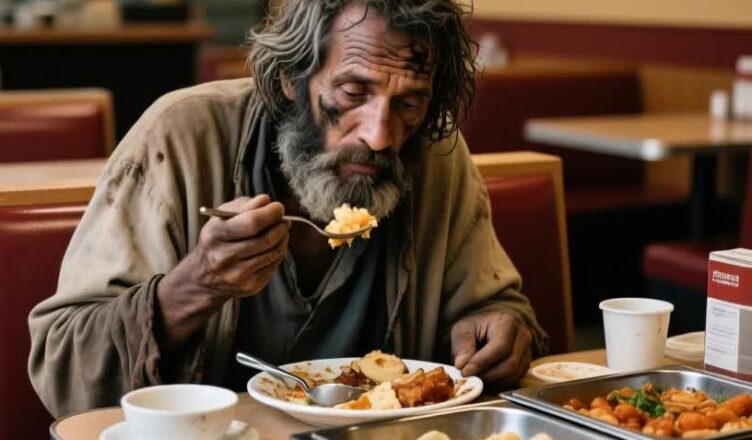
He entered the café, covered in soot, his shirt collar ripped, dirt smudging his chin, as if he had just crawled out from beneath the rubble of a collapsed building. No one stopped him, yet no one greeted him either. Whispers ran through the room. Two women at a nearby table leaned away, as if his presence might be contagious.
He settled at a table alone. He didn’t order anything. Instead, he carefully unfolded a napkin, laid it in front of him as though performing a ritual, and stared down at his hands.
After a while, the waiter approached hesitantly.
“Sir… can I help you?”
He shook his head silently.
“I’m hungry,” he said. “I came straight from the fire on Sixth Street.”
The café fell silent.
That morning, news had blared about a three-story apartment fire on Sixth Boulevard. Thankfully, no lives were lost: two residents had been evacuated through a side exit before the firefighters even arrived. Nobody knew who had rescued them.
Just then, a young woman in a leather jacket stood up. Five minutes earlier, she had rolled her eyes at his entrance; now, she sat across from him as if she’d known him for years.
“Hello,” she said, taking out her wallet. “Let me get you breakfast.”
He blinked, then nodded.
The waiter, still uncertain, took the order: pancakes, scrambled eggs, coffee—everything the man hadn’t requested.
“What’s your name?” the woman asked.
He paused.
“Artem,” he said.
The name sounded simple, calm—but his voice carried a fatigue so deep it left no doubt of the truth in his words.
She offered a faint smile.
“I’m Kira.”
He didn’t return it, only nodded, staring at his hands as if reliving a nightmare.
“I saw the news this morning,” Kira said. “They mentioned someone led people down the fire escape that was thought to be blocked.”
“Yes,” he replied without looking up. “It wasn’t completely blocked. Just smoke. People panicked.”
“You’re saying that was you?”
He shrugged.
“I was there.”
“You… lived in that building?” she asked.
He looked at her—tired, not angry.
“Not exactly. I was hiding in an empty apartment. I shouldn’t have been there.”
Their food arrived. Kira didn’t press further. She simply nudged the plate toward him.
“Eat,” she said quietly.
He didn’t use utensils, eating with his hands as if all manners had been forgotten. Other patrons watched, but quietly now.
After finishing half his eggs, he lifted his gaze.
“They were screaming. The woman couldn’t move. Her son, maybe six. I didn’t think—I just lifted them.”
“You saved them,” Kira said softly.
“Maybe.”
“You’re a hero.”
He gave a dry, tired smile.
“No. Just someone who has nothing left to lose.”
The words hung heavily. Kira remained silent, letting him finish. When he folded the napkin and tucked it into his pocket, she noticed his hands trembling.
“Are you okay?” she asked.
“Yeah. Just no sleep.”
“Do you have somewhere to stay?”
He didn’t answer.
“Need help?”
He only shrugged.
“Not the kind people usually offer.”
She hesitated, then asked, “Why the empty apartment? Were you homeless?”
He didn’t take offense.
“Kind of. I used to live there.”
“Used to?”
He stared at the table as if it held carved truths.
“My wife died a year ago. I lost the apartment. I couldn’t cope.”
Kira’s throat tightened. She hadn’t expected such honesty.
“I’m sorry,” she whispered.
He nodded and stood.
“Thanks for the food.”
“Won’t you stay a bit?”
“This isn’t my place.”
He turned to leave, but Kira stepped in front of him.
“Wait.”
He paused, wary but curious.
“You can’t just leave and vanish. You saved lives. That matters.”
He gave a sad smile.
“It won’t change where I sleep tonight.”
“Come with me,” she said.
“Where?”
“My brother runs a shelter. Small, imperfect, but safe and warm.”
He looked at her as if she had offered the impossible.
“Why?”
“Don’t know. Maybe because you remind me of my father. He fixed kids’ bikes just for the sake of it.”
Artem’s lips quivered. And he followed her.
Over the following months, the story unfolds: the shelter, reconnecting with the mother and son he saved, the building owner offering him work and a home, Artem gradually finding his footing again, helping neighbors, receiving a city award—and Kira, always there, believing in him even when he could not.
Under the stars one night, Artem finally whispered to Kira:
“Maybe… I do have a chance.”
For the first time, he truly believed it.
Life is strange: in its darkest moments, it often carves space for light. And sometimes, those we overlook carry the weight of an entire world on their shoulders.
If this story touched you, share it with someone who needs hope. Everyone deserves to be seen.