We descended the stairs past the peeling bulletin board plastered with flyers—parenting classes, AA meetings, a lost stuffed elephant painstakingly drawn by someone who had loved it—and the heavy front door groaned as I pushed it open, exhausted.
Outside, the winter morning slammed into us. The sky was a bruised purple-gray. The sidewalk, slick with leftover frost, glimmered faintly. Above us, the faded sign read:
SAINTE-BRIGIDE FAMILY SHELTER.
The word that lodged itself in my chest wasn’t shelter. It was family.
As if we weren’t people at all, just a category.
Laya adjusted her oversized backpack. I zipped her coat to her chin, trying not to show how completely I was unraveling inside.
“All right,” I forced a cheerful tone, playing pretend so she wouldn’t sense the panic, “the bus is coming in five minutes. We’re on time.”
She nodded solemnly. Laya carries quiet courage the way some people carry air: effortless, unnoticed, until you can’t imagine how anyone survives without it.
“Mama?” she whispered. “Do I still have to tell Mrs. Cole my address?”
My stomach twisted. School forms still listed my parents’ apartment. The word address had started to feel like a trap.
“I don’t think she’ll ask today,” I said.
A coward’s answer. She didn’t push it. She looked down at her worn, slightly-too-small shoes, then back at me—as if to check I was still myself, not a stranger wearing my skin.
“Mama,” she asked after a pause. “Are we moving again?”
I opened my mouth. Nothing came out.
I could have said: I don’t know.
I could have said: I hope not.
I could have lied: No.
But my throat had glued itself to every possible answer.
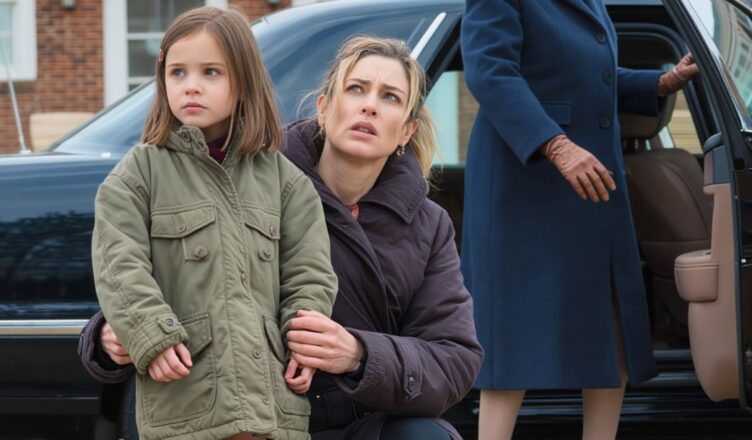
Then the black sedan slid up to the curb, as if it had taken a wrong turn from a richer, calmer neighborhood.
Sainte-Brigide didn’t get visits in sleek black sedans. We saw beat-up cars with trash bags on the backseat, rideshares with drivers who looked confused to be there. This car… it had purpose. It purred to a stop, silent, expensive.
Laya’s hand tightened around mine.
“Is it a taxi?” she asked.
“No,” I said automatically. “I—”
The rear door opened.
And she stepped out like a director had dropped her onto the wrong set. Midnight-blue tailored coat, heels that somehow didn’t sink into the cracked sidewalk, silver hair swept back in a style that said salon, not self-cut above the kitchen sink.
My grandmother, Evelyn Hart.
I hadn’t seen her in over a year, but she was exactly the same. Composed, elegant, vaguely terrifying—not cartoonishly, but in the way that could end a board meeting with a single raised eyebrow. As a child, my friends feared their bosses. I feared the disappointed silence of my grandmother.
Her eyes found me first. For half a second, her expression… faltered. Recognition, then confusion, then something I couldn’t name. Her gaze flicked to the sign above the shelter, then back to me, then down to Laya.
And that was when her face cracked.
Not fully. Not dramatically. But something splintered in her eyes. A hairline fracture in bulletproof glass.
“Maya,” she said.
She rarely used my first name. When she did, it meant I had to stand straighter, speak better, be better. Hearing it now, in front of a family shelter at six-twelve in the morning, felt like it belonged to someone else.
“What are you doing here?”
It wasn’t an accusation. Not really.
It was worse: total incomprehension, like the laws of her universe had been rewritten overnight.
The truth stuck behind my teeth. My first reflex—pathetic but honest—was to lie. Not because I thought she’d judge me, but because I couldn’t bear to be seen like this. Hair pulled into a crooked bun with a cheap elastic, coat missing a button, hands red and raw from industrial soap in the shared bathroom.
“I’m fine,” I said. The two most useless words in the vocabulary of a tired woman.
“We’re fine. It’s… temporary.”
Her eyes flicked to Laya’s mismatched socks. Then to my hands. I had this strange sensation of seeing myself from the outside—each cracked knuckle, each trace of dirt under my nails I hadn’t had the energy to scrub.
Her voice softened.
“Maya,” she repeated.
“Why aren’t you living in your Hawthorne Street house?”
The world… tilted.
For a second, I really thought I’d misheard. As if she had said something entirely different and my brain had auto-corrected it into nonsense.
“My… what?” I whispered.
After wrestling a coat that was far too thick onto a six-year-old in a shelter bathroom, my definition of what it meant to “have your life together” had become very flexible.
That morning, Laya sat on a folding chair, her shoes on the wrong feet, holding up two mismatched socks.
“It’s okay if they don’t match,” she murmured.
I knew it wasn’t really about socks. Being the shelter kid at school was heavy enough already.
We stepped out into the biting winter air, waiting for the school bus in front of the gray building. That’s when a sleek black sedan rolled to a stop. A woman stepped out—poised, certain, completely out of context.
My grandmother, Evelyn Hart.
Her eyes flicked from the shelter sign, to me, then to Laya. Her face froze.
“Why aren’t you living in the Hawthorne Street house?” she asked, calm, precise.
I had never heard of this house.
Hours later, sitting in a diner, pieces of the truth began to fall into place. Evelyn had set aside a home for me and Laya through a family trust. My parents were supposed to hand over the keys.
Instead… they had rented it to someone else, collecting the income for themselves.
Laya sipped a hot chocolate topped with whipped cream, oblivious to the storm brewing beside her. Evelyn, meanwhile, was on the phone with lawyers—quietly orchestrating the reckoning.
Three days later, at a large family gathering, the truth was unveiled. Documents, signatures, bank transfers. Evidence projected across a screen, undeniable.
My parents had profited from their own daughter’s absence. And most cruelly, from a child’s silence.
I left before it was over. I had nothing left to prove.
Six months later…
We live on Hawthorne Street.
The house isn’t perfect. But it’s ours. Laya knows the address by heart. She walks to school. She sleeps peacefully.
I’m still at the hospital, studying again, building a life that’s steady, not spectacular—but enough.
Some mornings, I think back to those mismatched socks.
They remind me that even in chaos, love and truth find their way.
And at last… we are home.