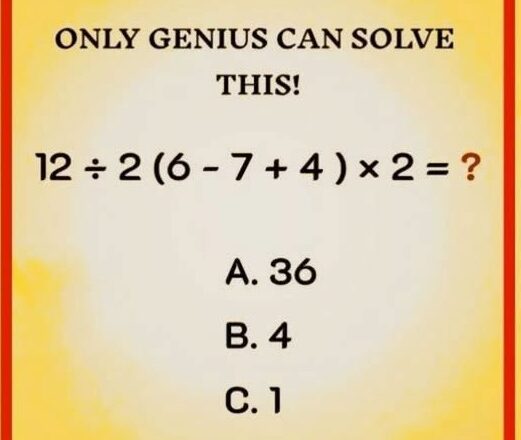
At first glance, this looks like a simple math problem that should take only a few seconds.
But there’s a small detail in the way the expression is written that can easily make you stop and think twice.
The puzzle asks you to solve the expression shown in the picture.
Before choosing an answer, don’t rush. The safest approach is to follow the standard order of operations carefully, step by step.
Step 1: Solve the Parentheses
Start with:
6 − 7 + 4
Subtraction and addition have the same priority, so we work from left to right.
6 − 7 = −1
Then:
−1 + 4 = 3
So the expression becomes:
12 ÷ 2(3) × 2
Now comes the tricky part.
Step 2: Follow the Order of Operations
Multiplication and division have the same priority in standard arithmetic.
So we work from left to right.
First:
12 ÷ 2 = 6
Then:
6 × 3 = 18
Finally:
18 × 2 = 36
So the answer is:
36
That means the correct choice in the puzzle is A. ✅
But Why Do Some People Get 4?
This is where the puzzle becomes confusing.
Some people interpret 2(3) as one grouped denominator, reading the expression as:
12 ÷ [2(3)] × 2
Then:
2 × 3 = 6
12 ÷ 6 = 2
2 × 2 = 4
That’s why answer B: 4 can seem convincing.
However, the original expression does not contain brackets showing that 2(3) should be treated as part of the denominator.
Under the conventional left-to-right rule for multiplication and division, the calculation gives 36.
This puzzle is therefore less about difficult math and more about carefully reading mathematical notation.
If the expression were intended to equal 4, it would be clearer to write:
12 ÷ [2(6 − 7 + 4)] × 2
The brackets would remove the ambiguity.
So, if you chose 36, your calculation follows the standard left-to-right convention.
If you chose 4, you noticed the ambiguity in the way the expression was written.
The important lesson is simple: slow down, simplify the parentheses first, and then carefully apply the order of operations.
Final Answer
🎯 A: 36
Did you get it right on your first try, or did the expression trick you? 🤔